Contents
Chapter 23
If two groups among believers fall to fighting, then make peace between them. (Al Hujurat, verse 9)
The purpose of Imam Bukhari from this chapter is to show that Almighty ALLAH calls the fighting parties as believers. Although the fighting groups are committers of a big sin. It is known from this hadith that, due to sins a muslim’s faith does not vanish making him a unbeliever. A muslim is called a disbeliever only when he disbeliefs.
The relation between the two chapters is that, in the first chapter it was stated regarding denial of ALLAH. And in this chapter it is talked regarding dis-obedience of ALLAH.
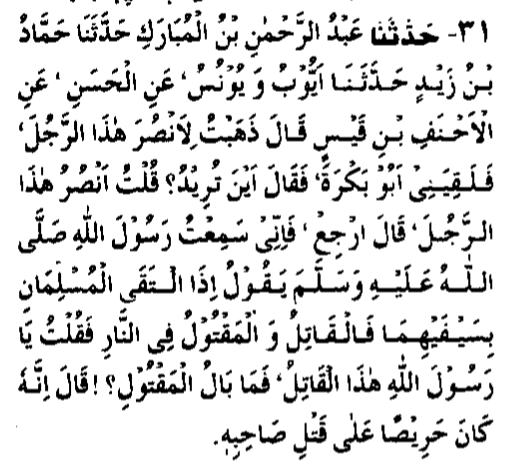
Hadith 31 in English
It is narrated by Al-Ahnaf bin Qais (May ALLAH be pleased with): While I was going to help this man (‘Ali bin Abi Talib) Abu Bakr met me and asked, “Where are you going?” I replied, “I am going to help that person.” He said, “Go back for I have heard Allah’s Messenger saying, ‘When two Muslims fight (meet) each other with their swords, both the murderer as well as the murdered will go to the Hell-fire.’ I said, ‘O ALLAH’s Messenger! It is alright for the murderer but what about the murdered one?’ Allah’s Messenger replied, ‘He surely had the (strong desire) intention to kill his companion’.”
When two muslims fight each other Explanation
It means when two Muslims fight without any valid Shariah reason to fight, the murderer, and the murdered both are sinful. And if there is a legitimate cause for the fight, the ruling is different. If anyone has a valid reason from the laws of shariah, it is permissible for him but in some cases he would be rewarded for his act. The sinner would be the one who has no legal reason for fighting. And if they both have a valid reason of Islamic permissibility, there would be no sin on either of the fighting party like it was the case in the War of Jamal and Siffeen.
The Mother of believers Ayesha and the companion of the prophet Mua’wiya (May ALLAH be pleased with them) considered the necessity of war based on their Ijtihad. And Ali (May ALLAH be pleased with) acted on his Ijtihad.
Although according to Ahl-e-Sunnat’s Scholarly consensus (ijma), Hazrat Ali was right and opposing party made a mistake in their ijtehad. And even if the mujtahid commits a mistake by chance, he and his followers receive one reward. It is prohibited to speak about the Companions conflicts which took place among themselves. Almighty ALLAH said about the companions in the Quran as, “And Allah has promised good to all“. (Surah Nisa, verse 95). Allah is pleased with them and they are happy with Allah. (Al-Hadid).
According to the right group of scholars, just thinking of committing a sin will not make the person a real sinner. But making a very strong intention of committing it as it happens between two fighting people during their fight to kill each other (selfishly) is a big sin. The hadith is pointing out that, even though both the murderer and the murdered are using their hands and legs to fight, the desire of killing is said to be the reason for entering into the hell. And this strong intention of desire is the task of the heart not of the other body parts.
Answers to few objections on this Hadith
The answers to the objections of the Hadith mentioned,
- It is objected to this Hadith that some of the Companions had fought with their Ijtihad, among them were killers and the killed. And they will be in paradise like the companions of the Jamal War and martyrs of Siffeen war, but it is stated in the hadith that when two Muslim fight, both murderers and the murdered are in hell? The answer to it is that this hadith is related to those Muslims whose war is not based on any Ijtihad, but only on the basis of self desires and grudges. And the basis of both sides fight is on evil and unjust.
- The second objection is that when Ali’s war with Mua’awiyah was based on Ijtihad, why did Abu Bakr forbid him from going to help Ali? Abu Bakr Siddiq’s precaution was based on this that, it was still not clear to him who was right. And in the view of the hadith, he understood that when two Muslims fight, none should be supported. Hanaf did not participate in the war of Jamal but later on, it became apparent to him that Ali was on right side. And he joined Ali in the war of siffeen. The prohibition of Abu Bakr (radiallahu a’nhum) was also based on Ijtihad itself.
- The third objection is that from the hadith, the killer and the killed are both in hell. It supports muta’azilla’s saying that it is obligatory to put the murderer and the murdered who are the committers of big sin in hell forever? The answer is that both the murderer and the murdered deserve the hell and the punishment. And Allah Almighty, by His Grace, forgives whomever He wills. After their punishment, they will finally be rescued from the hell.
- The fourth objection is that in this hadith, the reason for becoming dweller of hell for the victim is that he too was desiring for the murder of his companion, whereas just the desire without action should not be a sin? The answer to it is, the desire and strong intention to commit unlawful act is also a sin. Although its degree is somewhat less than the forbidden action (haram). When the victim was also attacking the person with a sword, this is somehow a big sin.
- The fifth objection is that in the verse Allah Almighty has called believers to both of them and in the Hadith, the Porphet said muslims to both of them? The answer is that it is laid emphasis here that the Muslim and the Believer are single.
Baab 23
Agar momineen ki do jamaa’tein aapas mein jang karein toh tum unke darmiyan sulah karao (Al Hujurat, 9) ALLAH ta’ala ne in dono jamaa’ton ko momineen farmaya.
Is baab se Imam Bukhari ka maqsad yeh hai keh ALLAH ta’ala ne ahle qitaal ko momineen farmaya hai. Halanke ahle qitaal murtakib kabeera hain. Isse maloom huwa keh gunah kabeera ke irtikab se insan iman se kharij hokar mushriq nahi banta.
In dono baabon mein munasibat yeh hai keh pehle baab mein ALLAH ke saath kufr ka bayan tha. Aur is baab mein ALLAH ki mua’asiyat ka zikr hai.
Hadith 31 In Roman Urdu
Imam Bukhari riwayat karte hain keh A’bdul Rah’man bin Al Mubarak ne hamein hadith bayan ki , inhone kaha: Hamein hammad bin zaid ne hadith bayan ki, inhone kaha: Hamein A’yyub aur Younus ne az Hasan az Al-hanaf bin Qais Hadith bayan ki, inhone kaha: Mai us shaks (Hazrat Ali) ki madad ke liye gaya toh mujhe Hazrat Abu Bakr mile. Pas mujhse pucha, tumhara kaha ka irada hai? Maine kaha, mai us shaks ki madad karunga. Inhone kaha, wapas jao, kyunke maine RasoolALLAH ko yeh farmate huwe suna hai: Jab do musalman apni talwaro se ladte hain toh qatil aur maqtool dono dozakh mein honge. Pas maine arz kiya, Ya RasoolALLAH! Yeh toh qatil hai, pas maqtool (ke dozakhi hone) ka kya sabab hai? Aap ne farmaya: Woh bhi toh apne saathi ke qatal par harees tha.
Tafsir
Ahnaf bin Qais: Tabae’e hai. Inka asal naam Dih’aak ya Sukhra hai. Mashoor Ahnaf ke saath hain. Ahnaf ka mana hai tede pao wala woh shaks jiska pao muda ho aur woh pao ki peeth ke bal chalta ho. Inhe zamana e aqdas mila. Usi ahad mein musalman bhi huwe lekin ziyarat se mehroom rahe.
Jab do musalman aapas mein ladein ki tashreeh
Isse murad jab do musalman na haq aapas mein ladein aur ladne ka koi sharai jawaz na ho,na qatil ke paas, na maqtool ke paas. Aur agar ladayi ki koi sharayi wajeh ho toh yeh hukum nahi. Agar sharayi jawaz ki wajeh kisi ke paas ho toh usay ladna jaiz balke ajar. Gunahgaar woh hoga jiske paas koi wajeh jawaz nahi.
Aur agar dono ke paas sharayi jawaz ki wajeh ho toh koi gunahgaar na hoga jaisa keh Jang e Jamal aur Siffeen mein tha. Hazrat Ayesha wa Hazrat Mua’wiya (radiallahu a’nhuma) ne apne ijtehad se ladayi ko zaruri jana. Aur Hazrat Ali (radiallahu a’nhu) ne apne ijtehad par amal farmaya. Agarche ba-ijmaa e Ahle Sunnat, Hazrat Ali haq par the aur unke muh’aaribeen se khata ijtehadi huwi. Aur mujtahid se agar khata e ijtehadi waqey ho toh bhi isay aur iske muqallideen ko ek sawab milta hai.
Sahaba e kiram ke aapasi mushajuraat (ikhtelaafat aur ladayi) mein kalam mana hai. ALLAH a’zzawajal ne tamam Sahaba e kiram ke liye farmaya, Aur ALLAH ne sabse bhalayi ka wada farmaya hai. (Surah Nisa, Ayat 95) ALLAH unse raazi huwa aur woh ALLAH se raazi huwe. (Al Hadeed).
Sahih wa muhaqqiq mazhab ke mutabiq gunah ka mehaz irada gunah nahi. Magar jab gunah ka itna pukhta a’zam karle jitna gunah ke irtikab ke waqt hota hai toh gunah ka aisa pukhta irada wa a’zam gunah hai. Yeh hadith ispar daleel hai, agarche yahan maqtool ne musalman ko qatal karne ke liye haath paaon chala magar hadith mein moujab e naar uski qatal hiris ko bataya. Aur hiris feil e qalb hai, feil e jawareh nahi.
Hadith mazkoora par aitarazaat ke jawabaat
- Is hadith par yeh aitraaz hota hai keh baaz Sahaba ne apne ijtehaad se qitaal (ladayi, jang) kiya, inme qatil aur maqtool the. Aur woh jannat mein honge jaise ke Jang e Jamal aur Jang e Siffeen mein shaheed hone wale Sahaba, halanke is hadith mein mutlaqan farmaya hai keh jab do musalman ladein toh qaatil aur maqtool dono dozakh mein hain? Iska jawab yeh hai keh yeh hadith un musalmano ke mutalliq hai jinki jang kisi ijtehad par mabni na ho, mahez hawase nafs ki bina par ho. Aur dono fareeqon ka mauqaf shar aur batil ho.
- Dosra aitraaz yeh hai keh jab Hazrat Ali ki Hazrat Mua’awiya se jang ijtihad par mabni thi toh Hazrat Abu Bakr ne Hazrat Ali ki madad ke liye jaane se kyu mana kiya tha? Hazrat Abu Bakr Siddique ka rokna is bina par tha yeh zahir na hosaka tha keh Haq par kaun hai? Aur zahir hadith ke aitbaar se inhone yehi samjha tha keh jab do musalman ladein toh kisi ka saath nahi dena chahiye. Hazrat Ahnaf jang e jamal mein shareek na huwe magar phir Hazrat Ali ka haq par hona inpar zahir hogaya. Aur jang e Siffeen mein Hazrat Ali ke sath shareek huwe. Lihaza Hazrat Abu Bakr ka mana karna bhi ijtehad par hi tha.
- Teesra aitraaz yeh hai keh is hadith mein hai keh qaatil aur maqtool dono dozakh mein hain. Isse muta’azzila ki tayeed hoti hai keh qaatil aur murtakib e kabeer ko hamesha ke liye dozakh mein dalna wajib hai? Iska jawab yeh hai keh iska meh’mal yeh hai keh qatil aur maqtool dono dozakh ke a’zaab ke mustahiq hain. Aur ALLAH ta’ala apne fazal se inme se jisko chahega muaf farmayega. Aur azab ke baad bil aakhir dozakh se rihayi payenge.
- Chautha aitraaz yeh hai keh is hadith mein apne maqtool ke dozakhi hone ki yeh wajeh bayan farmayi keh woh bhi apne saathi ke qatal par harees tha halanke iske qatal par harees toh gunah kabeera nahi hai? Iska jawab yeh hai keh haram kaam ki hirs aur iska pukhta irada bhi gunah e kabeera hai. Agarche yeh irtikab haram se kuch kam darje ka hai, jab keh woh maqtool bhi talwar se hamla kar raha tha. Yeh behar haal gunah e kabira hai.
- Panchwa aitraaz yeh hai keh us ayat mein ALLAH ta’ala ne dono ko momin farmaya hai aur hadith mein apne dono ko muslim farmaya hai. Iska jawab yeh hai keh isme tambeeh hai keh muslim aur momin wahid hai.